[ OPTICAL FORENSICS // ASTM D7391 STANDARD PRACTICE ]

ASTM D7391 OPTICAL SPORE TRAP QUANTIFICATION

VOLUMETRIC INERTIAL IMPACTION • 100% TRANSVERSE TRACE ENUMERATION • 400x/1000x OPTICS

The authoritative standard governing non-viable airborne fungal quantification is ASTM D7391-20. By drawing a precise volume of air through an inertial impaction slit onto an optically clear, adhesive-coated slide, spores are captured in a rectangular trace. Unlike retail culturing, optical microscopy detects both living and dead fungal structures, capturing the true toxigenic and allergenic biological load.

STAGE 01 // VOLUMETRIC CAPTURE

CALIBRATED AIRFLOW INTAKE

High-velocity air is drawn through Air-O-Cell or Allergenco-D cassettes at an exact 15.0 L/min flow rate for a 5-to-10 minute window (75L–150L total volume), ensuring uniform rectangular impaction without particle bounce.

ROTAMETER CALIBRATED • ZERO VOLUMETRIC DRIFT
STAGE 02 // BENCH ENUMERATION

100% TRANSVERSE TRACE SCAN

While budget clearinghouses scan only 10%–20% of the trace and multiply mathematically, Envirogyn analyzes 100% of the transverse trace width at 400x/1000x magnification. This ensures critical marker spores (*Stachybotrys*) are never missed.

ZERO FALSE NEGATIVES • 100% TRACE WIDTH AUDITED
STAGE 03 // STATISTICAL DERIVATION

SPORES/M³ CALCULATION

Raw spore counts are converted to airborne concentrations using the ASTM D7391 formula: Spores/m³ = (Raw Count / Trace Fraction) × (1000 / Volume L). Results are benchmarked against outdoor controls to classify Condition 1, 2, or 3 ecology.

ANSI/IICRC S520 BENCHMARKED • COURT ADMISSIBLE
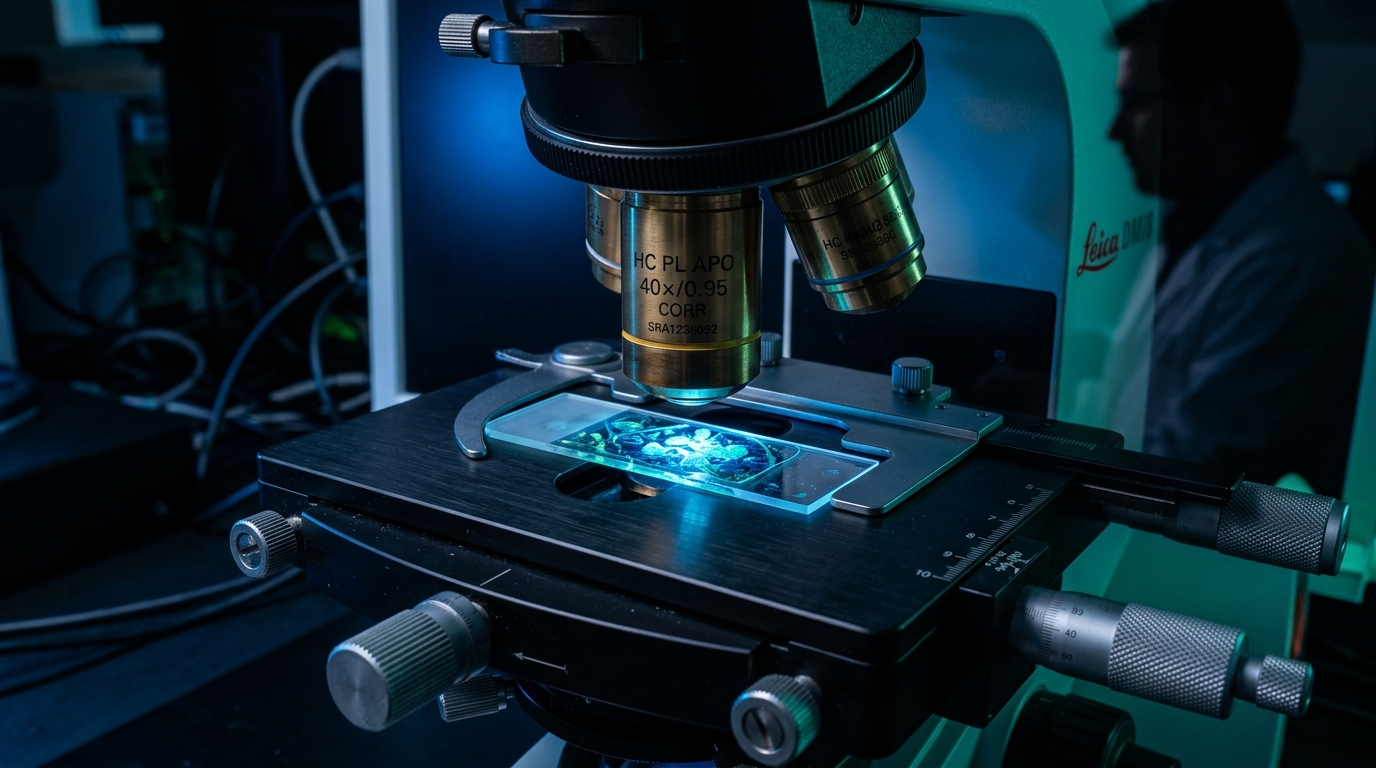
400x BRIGHTFIELD • RECTANGULAR IMPACTION TRACE ASTM D7391 Air-O-Cell optical spore trap impaction trace under compound microscope

FIGURE 2.1 // 400x TRANSVERSE SPORE TRAP ENUMERATION

Calibrated optical impaction trace showing distinct conidia clusters, background particulate matter, and hyphal fragment alignment across the transverse examination axis.

1000x OIL IMMERSION • CELLULAR ULTRASTRUCTURE High magnification 1000x oil immersion optical microscopy resolving micro conidia

FIGURE 2.2 // 1000x OIL IMMERSION RESOLUTION

High-power oil immersion resolution distinguishing individual small hyaline conidia (2.0–3.5 µm) of the *Aspergillus/Penicillium* group from non-fungal inorganic debris.

[ SPORE TAXA TAXONOMY // QUANTIFICATION BENCHMARKS ]

SPORE TAXA IDENTIFICATION & CONCENTRATION TABLE

EMPIRICAL ENUMERATION • RAW COUNTS • BIOMASS PERCENTAGE (%) • SPORES/M³

The table below displays real-world analytical results from a 75-liter volumetric spore trap sample (15.0 L/min for 5.0 minutes) evaluated under 100% transverse trace examination (analytical multiplier = 13.33 spores/m³ per raw spore counted).

SPORE TAXONOMIC IDENTITY ECOLOGICAL ROLE & TOXIN PROFILE RAW COUNT BIOMASS % CONCENTRATION (spores/m³) CLEARANCE THRESHOLD INTERPRETATION
Stachybotrys chartarum
TOXIGENIC BLACK ROT
Tertiary colonizer requiring prolonged high water activity (Aw > 0.90). Degrades cellulose (drywall paper). Produces macrocyclic trichothecenes (satratoxins G & H). 1 1.1% 13 spores/m³ ZERO TOLERANCE INDOORS.
Any detection signals active hidden water damage reservoir (Condition 3). Immediate containment required.
Chaetomium globosum
CELLULOLYTIC ASCOMYCETE
Soft rot indicator of chronic structural timber saturation. Lemon-shaped apiculate ascospores. Produces chaetoglobosins A & C (cytotoxic). 2 2.2% 27 spores/m³ ELEVATED RISK MARKER.
Presence confirms persistent roof or pipe leaks. Indicates structural framing degradation.
Aspergillus / Penicillium group
SMALL HYALINE CONIDIA
Xerophilic to hydrophilic micro-conidia (2–5 µm). Rapid aerosolizer. Deep alveolar lung deposition. Allergenic trigger and ochratoxin A producer. 38 41.8% 507 spores/m³ RATIO EVALUATION: Outdoor baseline = 160 spores/m³. Indoor/outdoor ratio of 3.17:1 indicates active indoor amplification reservoir.
Cladosporium spp.
PHYLLOPLANE FUNGUS
Most prevalent outdoor mold in Texas Gulf Coast air. Readily colonizes window frame condensation and HVAC evaporator coil drain pans. 18 19.8% 240 spores/m³ NORMAL INDOOR ECOLOGY: Outdoor baseline = 1,480 spores/m³. Indoor count represents normal ambient air infiltration.
Curvularia / Bipolaris
DEMATIACEOUS PHAEOPHYTES
Large multi-celled dematiaceous spores (18–35 µm). Outdoor plant pathogen. Can colonize persistently damp subflooring and carpet tack strips. 4 4.4% 53 spores/m³ BACKGROUND LEVEL: Outdoor control = 120 spores/m³. Typical outdoor tracking component.
Basidiospores & Ascospores
AMBIENT BACKGROUND CONTROL
Mushrooms, bracket fungi, and outdoor agricultural microflora naturally present in Gulf Coast ambient air currents. 28 30.7% 373 spores/m³ Outdoor baseline = 3,200 spores/m³. Lower indoor count confirms HVAC filtration efficiency.
TOTAL AIRBORNE FUNGAL LOAD (75 LITERS SAMPLED) 91 100.0% 1,213 spores/m³ EVALUATION: CONDITION 3 (ACTIVE AMPLIFICATION) due to confirmed presence of *Stachybotrys* and elevated *Aspergillus/Penicillium* ratio.
[ SURFACE FORENSICS // DIRECT MICROSCOPIC EXAMINATION ]

DIRECT SURFACE TAPE LIFT & SWAB MICRO-EXAMINATION

BIO-TAPE SAMPLING • FRUITING STRUCTURE PRESERVATION • BIOMASS COLONIZATION SCALE

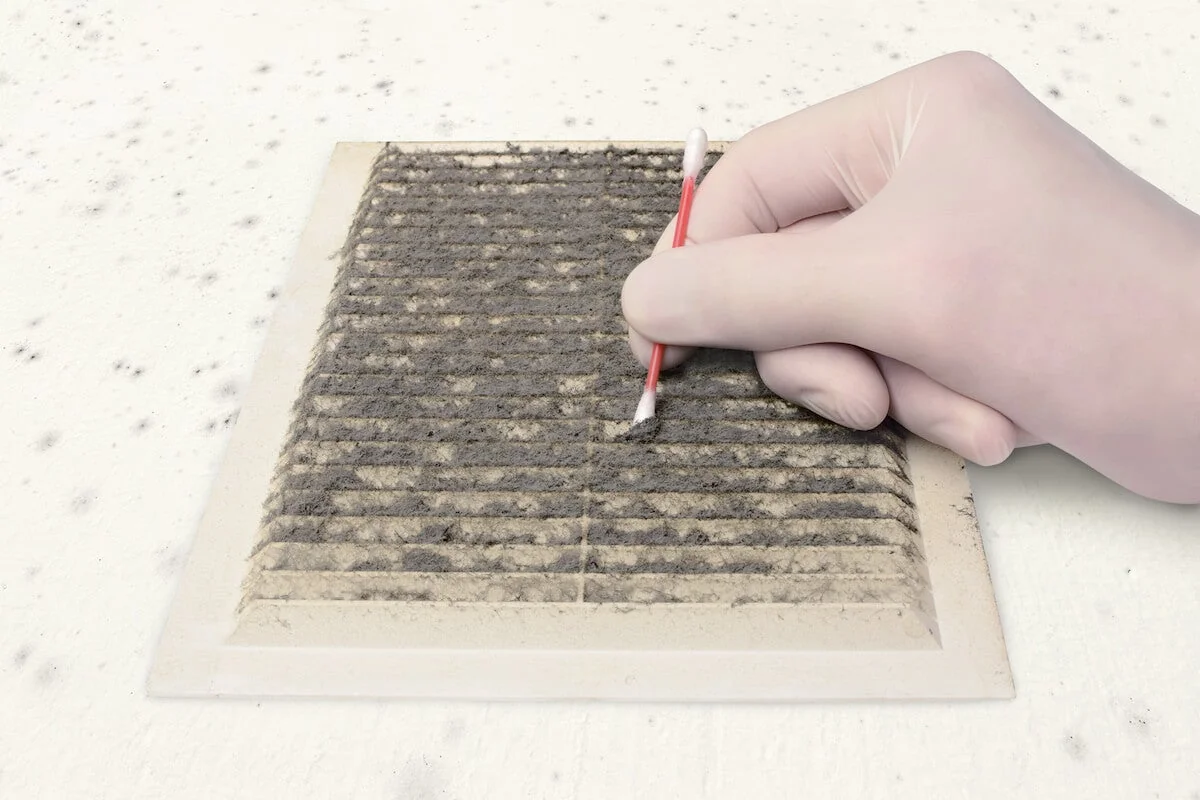
Air sampling captures aerosolized particulate, but wet, actively growing colonies of heavy-spored fungi (*Stachybotrys*, *Chaetomium*) rarely release spores into the air unless physically disturbed. Direct Microscopic Examination (DME) of adhesive bio-tape lifts provides definitive proof of vegetative colonization versus passive settled dust.

BIO-TAPE SLIDE • ACTIVE VEGETATIVE HYPHAE Direct mold swab and bio-tape lift surface sample examination in Texas City lab

FIGURE 3.1 // BIO-TAPE DIRECT SURFACE EXAMINATION: INTACT CONIDIOPHORES AND BRANCHING VEGETATIVE HYPHAE CONFIRMING ACTIVE STRUCTURAL MAT COLONIZATION.

[ QUANTITATIVE GRADING CRITERIA ]

BIOMASS COLONIZATION RATING SCALE

LEVEL 0 // NONE DETECTED: Zero fungal spores, hyphae, or fruiting structures observed across the entire slide.
LEVEL 1+ // RARE (1–10 SPORES): Scattered individual spores without vegetative hyphal growth. Typical of passive settled dust.
LEVEL 2+ // FEW (SCATTERED CLUSTERS): Small loose spore clusters with occasional non-branching hyphae. Early deposition phase.
LEVEL 3+ // MODERATE COLONIZATION: Multiple active colonies with branching vegetative mycelium and developing conidiophores.
LEVEL 4+ // HEAVY MYCELIAL MAT: Dense, multi-layered mycelial meshwork with massive active sporulation. Mature reservoir requiring remediation.
[ FORENSIC DECODER // LABORATORY CERTIFICATE OF ANALYSIS ]

CERTIFICATE OF ANALYSIS (CoA) FORENSIC DECODER

TRANSLATING RAW MICROSCOPY DATA INTO COURT-DEFENSIBLE PROPERTY INTELLIGENCE

Many laboratory data sheets are dense, impenetrable grids of acronyms designed to confuse property owners. Our forensic decoder breaks down the 6 critical analytical metrics on an official Envirogyn Certificate of Analysis.

METRIC 01 // CUSTODY ID

SAMPLE ID & CHAIN OF CUSTODY

Matches the physical cassette barcode to the electronic digital record (COA-SP-01-LIVING-ROOM). Guarantees specimen provenance in court.

METRIC 02 // AIR VOLUME

TOTAL VOLUME SAMPLED (L)

The total liters of air drawn across the impaction slit (75.0 Liters = 15.0 L/min for 5.0 minutes). Accurate volumetric measurement is vital for mathematical derivation.

METRIC 03 // RESOLUTION

ANALYTICAL SENSITIVITY

The concentration represented by a single raw spore (13.33 spores/m³). Calculated as: 1000 / (Volume × Trace Fraction). Lower numbers equal higher analytical sensitivity.

METRIC 04 // BENCH TALLY

RAW PHYSICAL COUNT

The actual number of fungal structures observed under the microscope during the complete 100% transverse trace pass. Never estimate or guess.

METRIC 05 // FINAL CONC

CONCENTRATION (SPORES/M³)

The final normalized density of airborne spores per cubic meter of air (Raw Count × Sensitivity). Enables standardized comparison across rooms and outdoor baselines.

METRIC 06 // ECOLOGY COMPARATOR

OUTDOOR CONTROL BASELINE

The reference air sample collected outdoors concurrently. An indoor elevation of xerophilic fungi or any presence of toxigenic marker spores confirms an active mold reservoir.

[ DIY CONSUMER & CONTRACTOR TEST PORTAL // ALL-INCLUSIVE ]

PROFESSIONAL DIY MOLD TEST KIT

Avoid misleading big-box store gravity settle plates. Our professional test kits include sterile laboratory-grade bio-tape slides, pre-paid return shipping direct to our Texas City bench, and an official state-accredited Certificate of Analysis signed by our Medical Laboratory Scientist under TDLR LAB #1050.

  • ✓ 3x Sterile Bio-Tape Sampling Slides: High-adhesion optical cassettes for drywall, trim, framing, or AC coils.
  • ✓ Pre-Paid Return Priority Mailer: Rapid shipment directly to Envirogyn Texas City Lab HQ.
  • ✓ Accredited Lab Analysis Included: Zero hidden bench fees or surprise processing add-ons.
  • ✓ 24-Hour STAT Turnaround: Digital CoA delivered to your email within 24 hours of receipt.
DIY LAB KIT // PREPAID EXPEDITED RETURN MAILER Professional DIY mold test kit sampling materials and prepaid return mailer
[ MOLD LAB INTEL // FREQUENTLY ASKED QUESTIONS ]

MOLD ANALYSIS LABORATORY FAQ BRIEFING

TDLR LAB #1050 • ASTM D7391 • 16 TAC § 78.50 COMPLIANCE

WHY ARE HARDWARE STORE PETRI DISH SETTLE TESTS SCIENTIFICALLY INVALID?

Gravity settle dishes rely on spores randomly drifting onto an agar plate. Because they do not draw a known volume of air (zero liters sampled), they cannot calculate spores per cubic meter (spores/m³). Crucially, small toxigenic spores (*Aspergillus/Penicillium*) remain suspended indefinitely in ambient air and rarely settle, whereas heavy, harmless outdoor plant spores drop rapidly. Gravity settle tests are explicitly rejected by ASTM D7391 and carry zero legal admissibility in Texas real estate closings or insurance claims.

WHAT SPORE COUNT NUMBER PROVES A BUILDING HAS AN ACTIVE MOLD PROBLEM?

There is no single statutory "magic number" because outdoor background spore counts in Texas fluctuate from 500 to 50,000+ spores/m³ depending on rainfall and wind. Instead, ASTM D7391 and ANSI/IICRC S520 require a differential comparison between indoor samples and concurrent outdoor control samples. Active amplification (Condition 3) is proven when indoor spore levels significantly exceed outdoor levels, when indoor taxa are dominated by water-damage species (*Penicillium*, *Aspergillus*) while outdoor air is dominated by *Cladosporium*, or when toxic marker molds like *Stachybotrys* are detected.

WHY DOES A 100% TRANSVERSE SCAN MATTER FOR TOXIGENIC MARKERS?

Toxigenic species like *Stachybotrys chartarum* produce large, heavy, sticky spores that are released in low airborne concentrations. If an air sample contains only 1 or 2 *Stachybotrys* spores, a retail laboratory scanning only 10% or 20% of the trace has an 80% to 90% mathematical probability of missing them entirely—falsely certifying the air as clean. Envirogyn's protocol mandates a 100% transverse trace examination under 400x/1000x magnification, completely eliminating sampling blind spots.

ARE ENVIROGYN CERTIFICATES OF ANALYSIS ACCEPTED FOR TEXAS TDI MDR-1 CLOSINGS?

Yes. Envirogyn is an accredited Mold Analysis Laboratory licensed under TDLR LAB #1050. Our analytical data packages fully comply with Texas Administrative Code (16 TAC § 78.50) and are formally accepted by independent licensed Mold Assessment Consultants (MAC), property underwriters, title companies, and the Texas Department of Insurance for issuing Certificate of Mold Damage Remediation (TDI Form MDR-1) clearance certificates.

READY TO COMMISSION MOLD SPORE ANALYSIS?

Direct sample drop-off at Texas City headquarters, rapid 3-hour emergency STAT bench service, or turnkey professional mail-in test kit ordering.