Certificate of Mold Damage Remediation (CMDR)
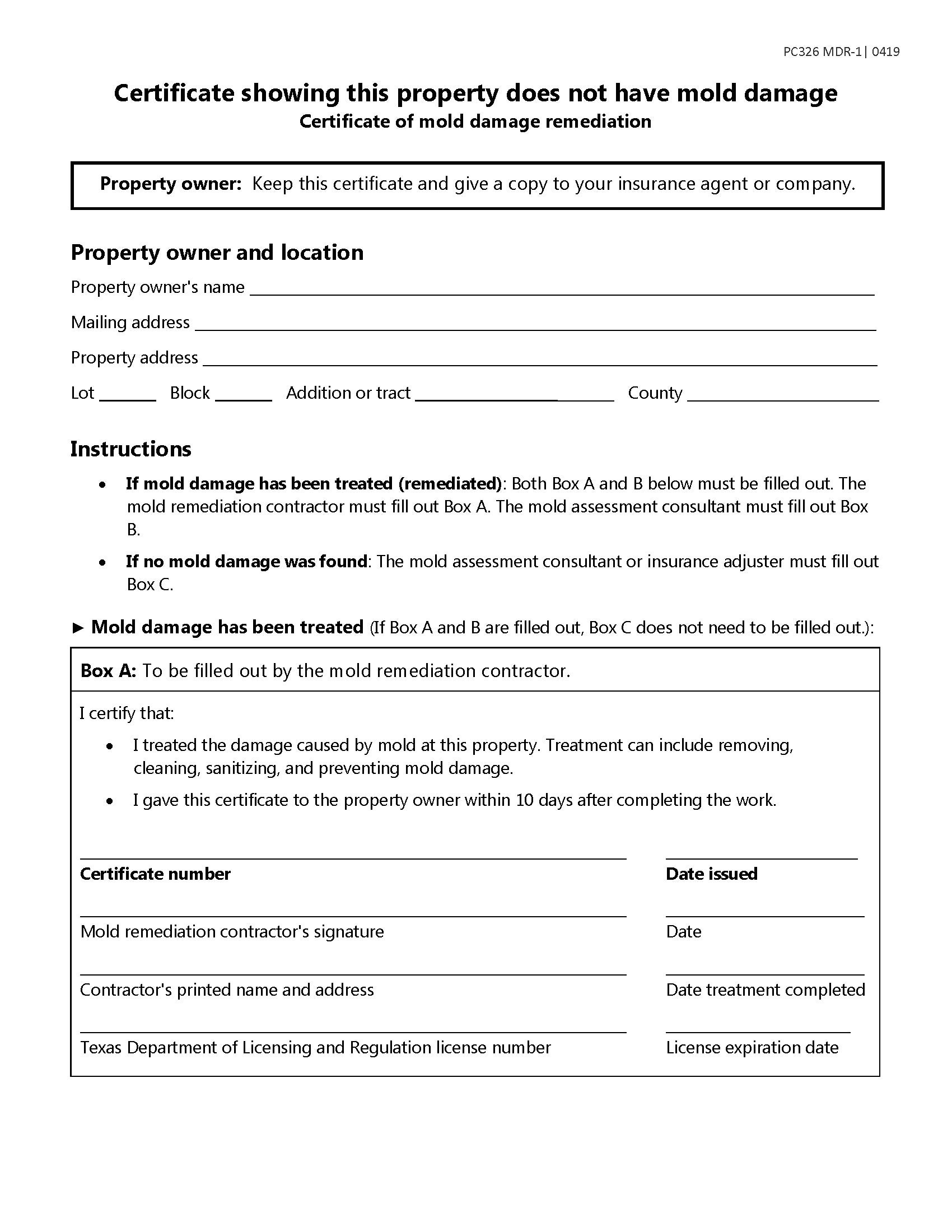
The definitive legal certification adopted by the Texas Department of Insurance (TDI Form MDR-1). Verifying that your real property has been remediated in strict accordance with the state-approved protocol, restoring full insurable standing and statutory immunity.
The Gold Standard for
Healthy Properties.
The CMDR is more than just a piece of paper; it is an official document issued under the authority of the Texas Department of Insurance (TDI) and Texas Department of Licensing and Regulation (TDLR) verifying that a property has been successfully remediated.
When you hold a CMDR from Envirogyn, you have indisputable proof that your space has met rigorous state standards for mold removal. Our licensed Mold Remediation Contractors (MRC #1611) and Assessment Consultants (MAC #1544) adhere to strict TDLR protocols (16 TAC Chapter 78) to ensure your environment is safe for your family or employees.
Under Texas law, an insurer may not make an underwriting decision, charge a rate surcharge, or refuse coverage regarding property insurance based on previous mold claims if an official CMDR has been filed confirming complete remediation.
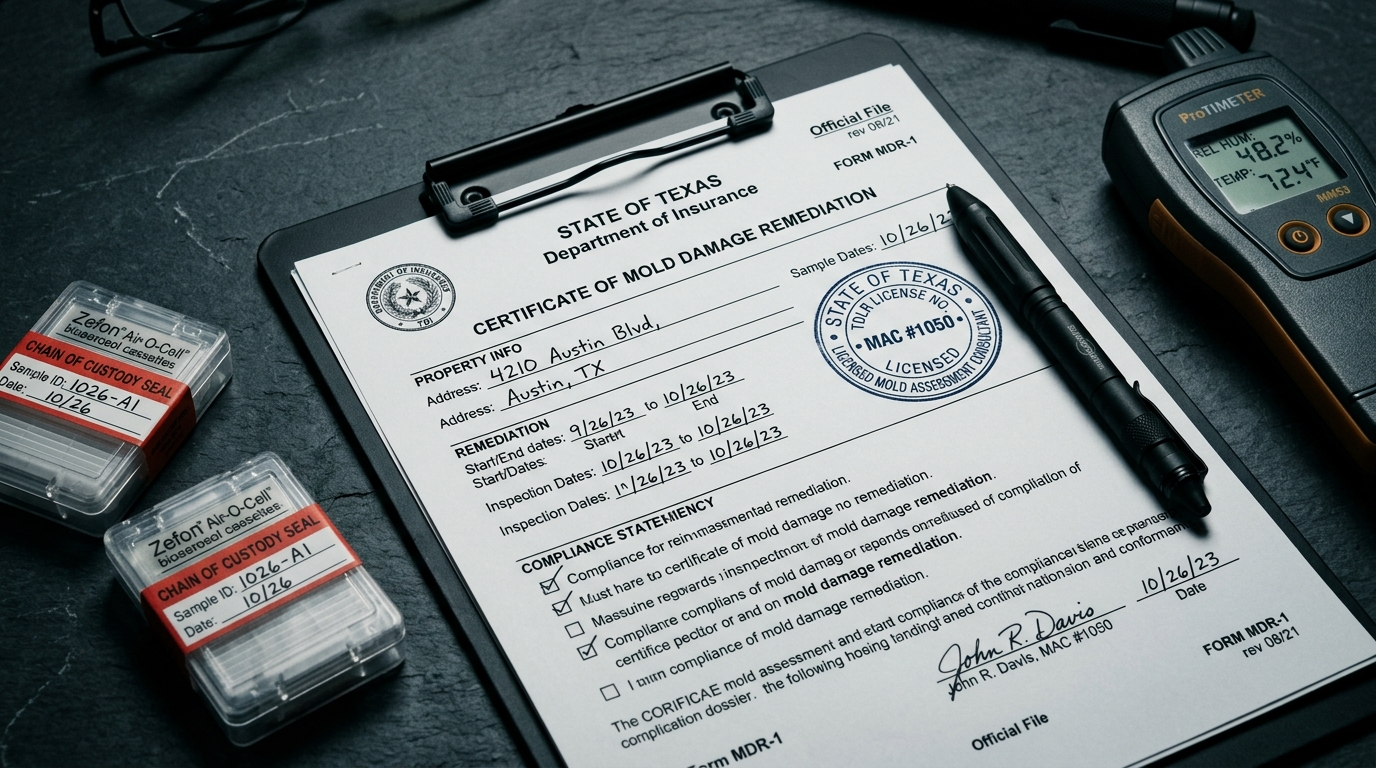
Three Critical Advantages of the Official CMDR
Proof of Remediation
Legal documentation proving professional mold removal was completed successfully. Signed by both the licensed contractor and an independent assessment consultant, Form MDR-1 is recognized by Texas courts, title attorneys, and municipal authorities.
Increased Property Value
Vital for real estate transactions, assuring buyers and mortgage underwriters the property is safe, clean, and fully insurable. Having a CMDR in your disclosure package prevents price renegotiation or transaction cancellations.
Total Peace of Mind
Rest easy knowing your home or business has been certified mold-free by licensed state experts. Third-party laboratory air cassettes prove spore concentrations are statistically lower than outdoor baseline benchmarks.
The 4-Phase Path to CMDR Certification
Every step required under 16 TAC § 78.68 must be successfully executed before the final Certificate of Mold Damage Remediation can be legally signed and delivered.
Thorough inspection to identify the mold source, moisture intrusion mechanism, and spatial extent. We develop a tailored remediation plan (protocol) specific to your property, defining engineering containment, PPE, and clearance benchmarks.
Collection of samples to scientifically confirm mold species, genus, and baseline levels. In-house direct microscopic examination (ASTM D7391) guarantees our protocol is data-driven, defensible, and objectively verifiable.
Safe removal of contaminated materials and rigorous cleaning of the area using EPA-registered antimicrobials under negative air pressure containment (≥ 4.0 ACH). The remediation contractor certifies that the underlying moisture source has been remediated.
Post-remediation verification (PRV) to confirm success. The licensed consultant performs visual and analytical air testing inside containment. Upon passing, we execute and issue the official Certificate of Mold Damage Remediation within 10 days.
Essential CMDR Inquiries & Answers
What types of properties does the CMDR apply to?
It applies to both residential (homes, condominiums, multi-family apartments) and commercial properties (offices, schools, municipal complexes, healthcare facilities) in Texas where professional remediation has occurred under TDLR 16 TAC Chapter 78. Any project covering ≥ 25 contiguous square feet of visible mold is required to follow the statutory protocol and receive a CMDR upon passing.
What methods do you use during remediation?
We use EPA-registered antifungal products, hospital-grade HEPA vacuuming, and physical removal of non-salvageable porous materials. Our technicians follow strict safety protocols including 6-mil polyethylene containment, zippered negative-pressure airlocks, and industrial air filtration devices maintaining ≥ 4.0 air changes per hour.
Is the process safe for occupants?
Yes. Safety is our priority. Technicians use full personal protective equipment (PPE), containment barriers, and negative air machines that continuously exhaust filtered air to the outdoors, preventing mold spores from migrating into clean living or working spaces. Occupants are protected from exposure throughout the entire lifecycle.
Secure Your Property's CMDR Today
Need a Certificate?
Ensure your property is officially cleared and legally protected. Schedule an inspection with our certified team today to initiate the clearance verification process.
The 5-Step Process
Understand each phase of the remediation journey from preliminary survey and protocol design to critical containment and final clearance.
HVAC Air Conveyance Protocol
Mold in air handling units, cooling coils, or flex ductwork requires specialized TDLR-compliant air conveyance assessment before CMDR sign-off.