[ RESTORATION // 02.2 // TDLR LICENSED MRC #1611 CONTRACTOR ]

MOLD REMEDIATION & HEPA BIO-CONTAINMENT

State-notified mold remediation contracting, engineered 6-mil negative-pressure biocontainment, 99.97% HEPA air scrubbing, and independent third-party Post-Remediation Verification. Operating under Texas Department of Licensing and Regulation (TDLR) Mold Remediation Contractor License #1611 across Houston, Galveston, and the Texas Gulf Coast.

CONTRACTOR LICENSURE TDLR MRC #1611
STANDARD OF CARE ANSI/IICRC S520
STATE NOTIFICATION 5-DAY MANDATED TDLR FILING
STATUTORY AIR-GAP 100% ENFORCED (16 TAC § 78)
BIO-CONTAINMENT // UNIT 02 Envirogyn Mold Remediation transformation and structural timber decontamination
CONTRACTOR CAPABILITY DOSSIER

CONTROLLED BIOCONTAMINATION REMEDIATION

Complete environmental isolation, negative-pressure HEPA filtration, source substrate removal, and fungicidal antimicrobial encapsulation strictly conforming to third-party assessment protocol blueprints.

[ ENGINEERING STANDARD OF CARE ]

THE ANSI/IICRC S520 7-STEP REMEDIATION ROADMAP

Mold remediation is an engineered biohazard abatement discipline governed by Texas Administrative Code Title 16 Chapter 78 and ANSI/IICRC S520. Envirogyn executes physical remediation through a rigorous 7-stage protocol engineered to achieve absolute microbial clearance.

STEP 01 // PROTOCOL REVIEW & STATE FILING 16 TAC § 78.54 COMPLIANCE

Independent Protocol Analysis & 5-Day TDLR Notification

Prior to touching a single wall, Envirogyn reviews the legally binding Mold Remediation Protocol prepared by an independent licensed Mold Assessment Consultant (MAC). Our team drafts the official Mold Remediation Work Plan (MRWP) outlining specific containment dimensions, equipment sizing, and personal protective equipment. On regulated projects (≥ 25 contiguous sq ft), we submit the mandatory 5-day state notification to TDLR (or emergency waiver documentation for active water leaks).
STEP 02 // CRITICAL CONTAINMENT ENGINEERING ANSI/IICRC S520 BARRIERS

Critical Containment & 3-Stage Decontamination Air-Locks

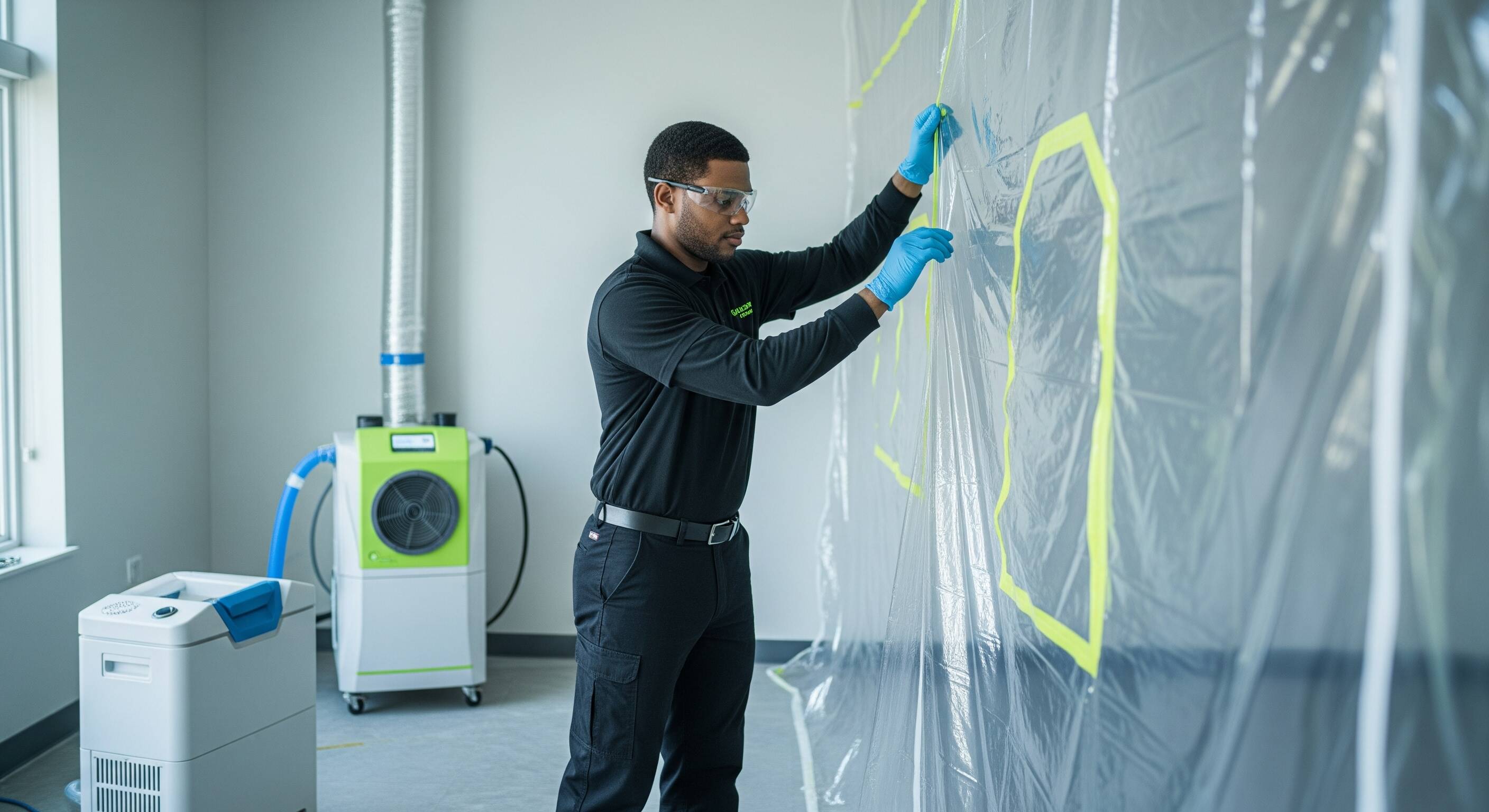
Technicians construct heavy-duty critical isolation barriers using true 6-mil flame-retardant virgin polyethylene sheeting anchored with mechanical tension poles and airtight perimeter gaskets. All HVAC supply vents, return grilles, and electrical conduits are sealed with double poly layers to eliminate cross-contamination. Entrance to the work area is controlled via a zippered 3-stage decontamination air-lock chamber with negative pressure flap doors.

Envirogyn mold remediation critical containment poly barrier setup
6-MIL VIRGIN POLY CRITICAL CONTAINMENT ISOLATION
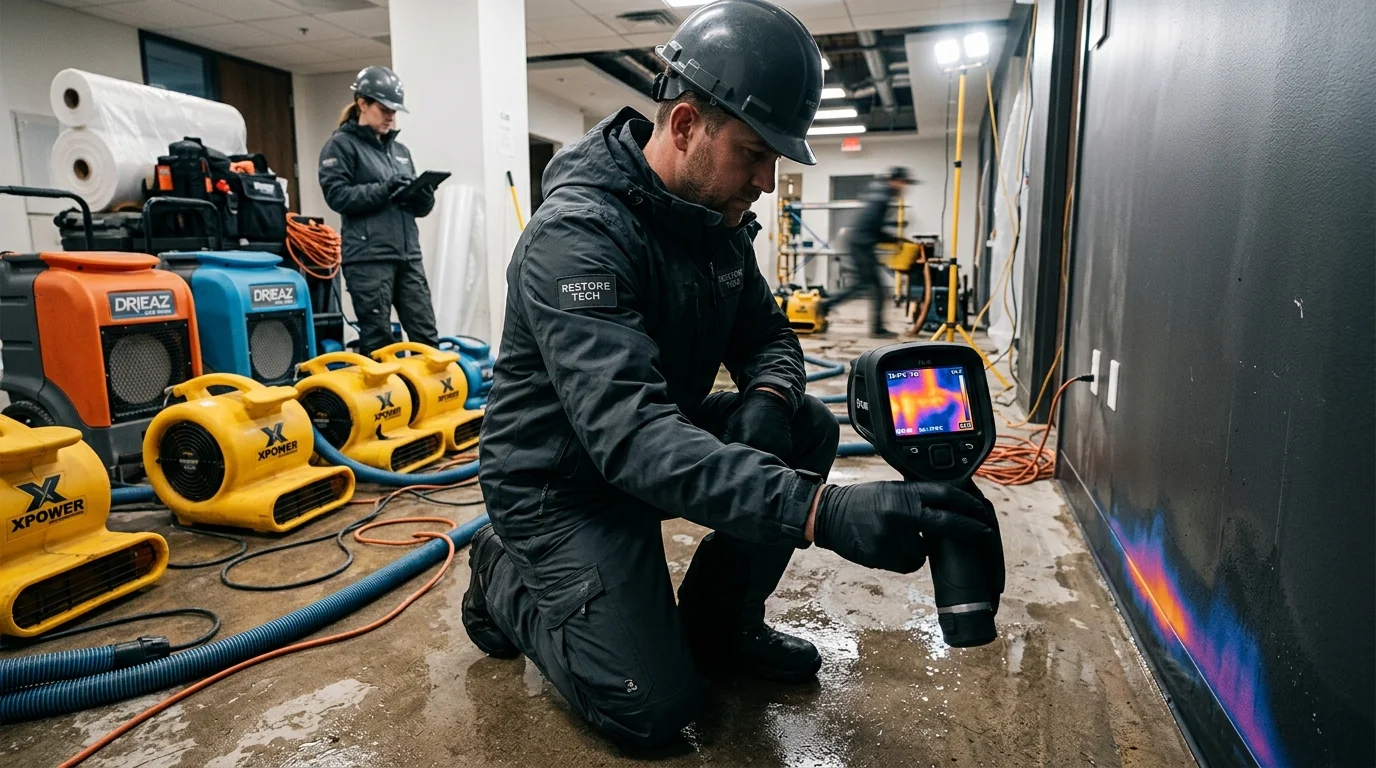
Active negative-pressure containment zone in commercial building
ZIPPERED DECONTAMINATION AIR-LOCK CHAMBER
STEP 03 // HEPA NEGATIVE AIR PRESSURE -0.02 IN. W.G. DIFFERENTIAL

Continuous Negative Air Pressure & HEPA Filtration

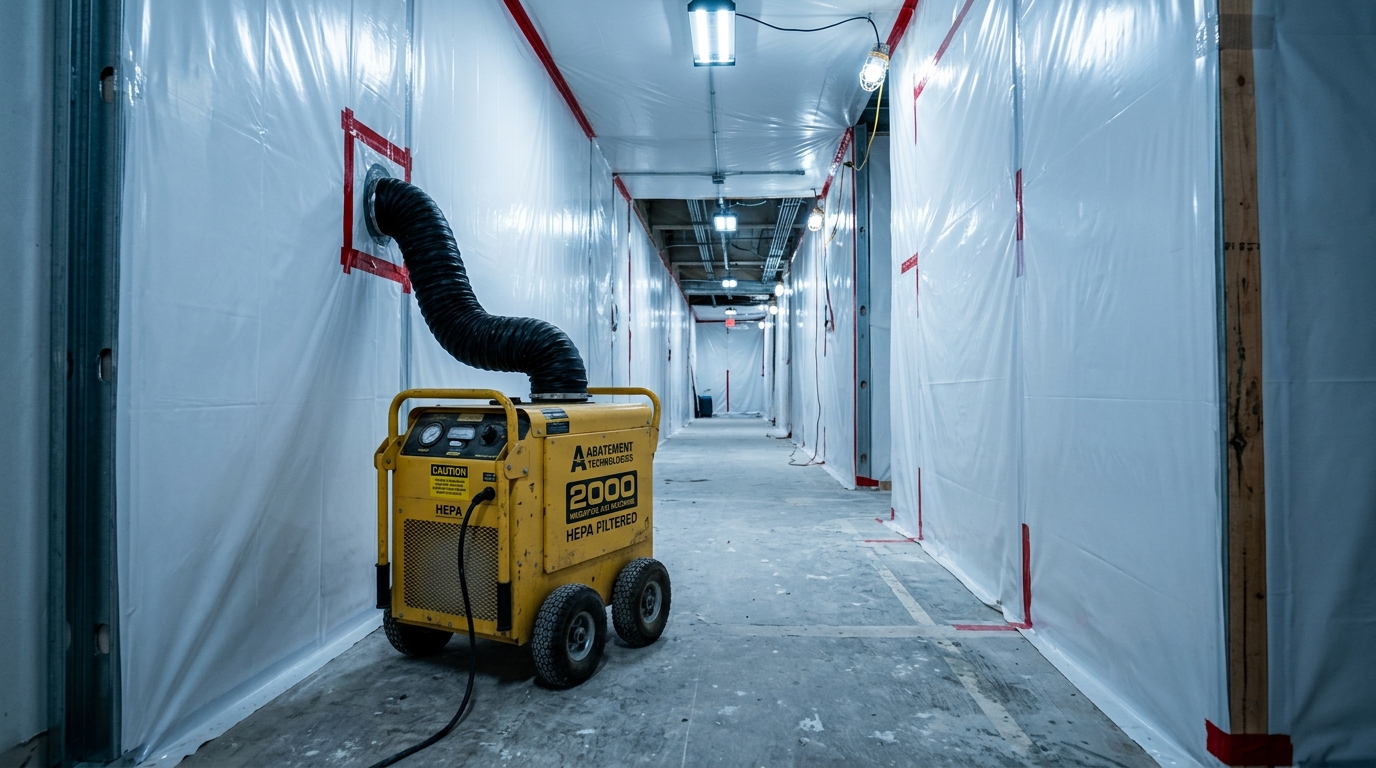
Industrial Air Filtration Devices (AFDs) fitted with DOP-tested 99.97% true HEPA filters (rated at 0.3 microns) are activated before any demolition occurs. We calibrate units to maintain a continuous negative pressure differential between -0.02 and -0.03 in-WC (-5.0 to -7.5 Pa) relative to surrounding habitable zones, verified 24/7 by digital datalogging manometers. Negative exhaust is vented directly to the exterior, ensuring 4 to 8 full air changes per hour (ACH).

Industrial HEPA negative air scrubber running in containment zone
COMMERCIAL HEPA AIR FILTRATION (99.97% @ 0.3 µm)
STEP 04 // CONTROLLED SUBSTRATE REMOVAL SURGICAL DEMOLITION

Controlled Source Removal & HEPA Sanding

Porous materials with deep fungal colonization (drywall, fiberglass insulation, ceiling tiles, tack strips) cannot be successfully decontaminated and are excised under controlled conditions. Technicians cut cleanly 12 to 24 inches beyond visible fungal boundaries, placing debris directly into double 6-mil poly bags inside containment. Bag exteriors are HEPA-vacuumed and wiped before removal through the air-lock. Exposed structural timber framing is then mechanically sanded or wire-brushed under direct HEPA point-of-source vacuum extraction.

STEP 05 // HEPA SANDWICH PROTOCOL 3-STAGE MICRO-CLEANING

HEPA Sandwich Vacuuming & Antimicrobial Washdown

All non-porous and semi-porous surfaces undergo our rigorous 3-stage "HEPA Sandwich" decontamination sequence:

• First Pass: Slow, overlapping contact HEPA vacuuming of all exposed structural framing, joists, subfloors, and containment poly walls.
• Second Pass: Damp-wiping every square inch with an EPA-registered hospital-grade quaternary or botanical antimicrobial solution using micro-fiber cloths folded into 8 clean faces.
• Third Pass: Final contact HEPA vacuuming performed after a mandatory 2-hour airborne particle settling window.

STEP 06 // STRUCTURAL ENCAPSULATION EPA-REGISTERED FUNGICIDAL SEALANT

EPA-Registered Antimicrobial Encapsulation

Following thorough decontamination and verification that structural moisture content is below 15% WME, technicians apply an EPA-registered fungicidal elastomeric coating / encapsulant to exposed timber framing, roof rafters, and subflooring. This commercial-grade coating creates an impenetrable barrier that resists moisture intrusion, binds residual microscopic carbon particles, and permanently prevents fungal re-colonization.

EPA-registered antimicrobial encapsulation applied to timber framing
EPA FUNGICIDAL ELASTOMERIC STRUCTURAL ENCAPSULATION
STEP 07 // INDEPENDENT PRV CLEARANCE TDI FORM MDR-1 ENDORSEMENT

Independent 3rd-Party Post-Remediation Verification (PRV)

Containment barriers and negative pressure remain fully operational and pressurized. In strict compliance with the Texas Statutory Air-Gap (16 TAC § 78.70), an independent licensed Mold Assessment Consultant (MAC) enters the containment to conduct a comprehensive visual dust inspection and collect calibrated bioaerosol spore trap samples. Once laboratory analysis confirms normal fungal ecology (Condition 1), Envirogyn executes Section 1 of TDI Form MDR-1, and the MAC executes Section 2, certifying the project clear.

[ EMPIRICAL PROOF OF PERFORMANCE ]

AUTHENTIC RESTORATION SHOWCASE

Unretouched photographic evidence from real-world Envirogyn remediation deployments across residential and commercial structures on the Texas Gulf Coast.

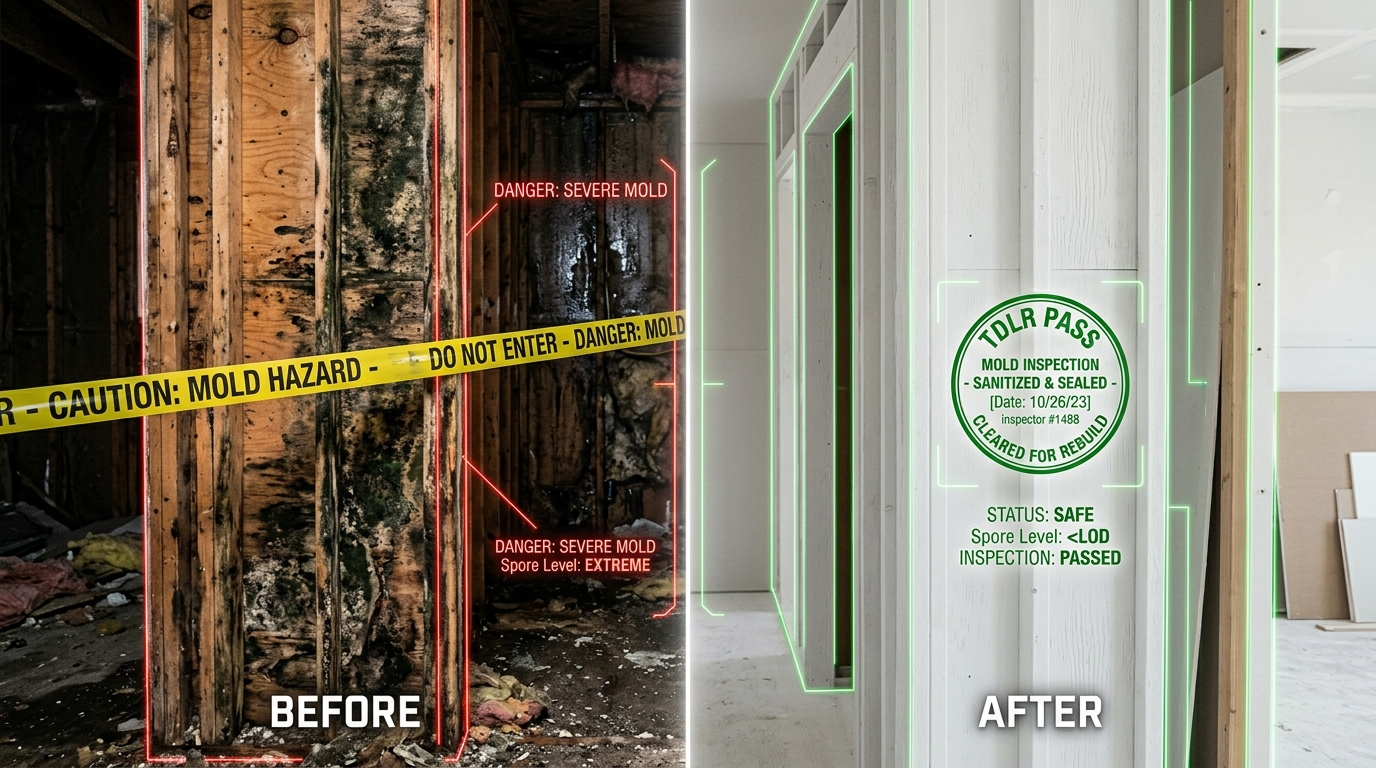
CASE 01 // STRUCTURAL FRAMING ABATEMENT Before and after mold abatement on wooden framing studs
TIMBER DECONTAMINATION • GALVESTON COUNTY

STRUCTURAL TIMBER COLONIZATION VS. RESTORED

Heavy Stachybotrys and Chaetomium mycelial colonization on 2x4 framing studs caused by hidden plumbing wall cavity leak. Remediated via HEPA sanding, antimicrobial wash, and sealed with EPA fungicidal encapsulant.

RESULT: Post-Remediation Verification Passed • Zero Detected Mycotoxins.
CASE 02 // POST-PRV RESTORED ENVELOPE Restored residential interior room following certified mold remediation
FULL HABITABLE RESTORATION • HOUSTON METRO

COMPLETE INTERIOR LIVING ENVELOPE REBUILD

Following certified containment teardown and independent PRV clearance, the room was rebuilt with mold-resistant gypsum board, primed, and restored to turnkey condition with full TDI Form MDR-1 certification.

RESULT: Condition 1 Normal Fungal Ecology • TDI Form MDR-1 Issued.
[ CONSUMER PROTECTION & ZERO CONFLICT OF INTEREST ]

THE TEXAS STATUTORY AIR-GAP FIREWALL

Under Texas law, consumer protection is codified by statute. Texas Occupations Code Chapter 1958 and 16 Texas Administrative Code § 78.70 mandate a strict separation of powers between mold assessment and mold remediation.

TEXAS OCCUPATIONS CODE § 1958.155 & 16 TAC § 78.70

WHY THE AIR-GAP PROTECTS YOUR PROPERTY VALUE

In unregulated states, predatory restoration companies perform tests, write inflated repair estimates, complete sloppy work, and then "clear" their own jobs. In Texas, this practice is illegal. On any regulated project involving 25 or more contiguous square feet of visible mold:

  • • Separation of Roles: The licensed Mold Assessment Consultant (MAC) who authors the remediation protocol CANNOT perform the physical remediation.
  • • Objective Clearance Gate: The remediation contractor CANNOT perform their own Post-Remediation Verification. Clearance must be independently tested and certified by a third-party MAC.
  • • Legal Insurance Immunity: When Envirogyn performs remediation as TDLR MRC #1611, an independent MAC verifies clearance, guaranteeing that insurance adjusters, lenders, and real estate underwriters accept your Certificate of Mold Damage Remediation (CMDR).
[ STATUTORY AIR-GAP PROTOCOL MATRIX ]
REGULATED SCOPE ≥ 25 CONTIGUOUS SQ FT
PROTOCOL AUTHOR INDEPENDENT LICENSED MAC
PHYSICAL CONTRACTOR ENVIROGYN (TDLR MRC #1611)
CLEARANCE INSPECTOR INDEPENDENT LICENSED MAC
LEGAL INSTRUMENT TDI FORM MDR-1 (CMDR)
ZERO CONFLICT OF INTEREST • FULL CONSUMER PROTECTION
[ REGULATORY CERTIFICATE OF CLEARANCE ]

TDI FORM MDR-1 CONTRACTOR CERTIFICATION WORKFLOW

The Texas Department of Insurance (TDI) Certificate of Mold Damage Remediation (Form MDR-1) is the only legally recognized document that clears mold from a property's permanent title history and protects against insurance rate penalties under Texas Insurance Code § 544.303.

STAGE 01 // EXECUTION

SECTION 1: CONTRACTOR CERTIFICATION

Upon completing all containment, surgical removal, HEPA cleaning, and antimicrobial encapsulation, Envirogyn LLC signs Section 1 of Form MDR-1 under penalty of law, certifying that the work conformed strictly to the independent protocol.

STAGE 02 // CLEARANCE

SECTION 2: CONSULTANT VERIFICATION

The independent third-party Mold Assessment Consultant conducts visual inspection and bioaerosol air sampling inside containment. Upon laboratory verification of Condition 1 clearance, the MAC signs Section 2, verifying successful remediation.

STAGE 03 // STATUTORY DELIVERY

SECTION 3 & OWNER DELIVERY (10 DAYS)

Under 16 TAC § 78.64, the completed Certificate of Mold Damage Remediation must be delivered to the property owner within 10 days of passing clearance, preserving property value for resale, refinancing, and insurance underwriting.

[ TECHNICAL FAQ BRIEFING ]

MOLD REMEDIATION CONTRACTOR INTELLIGENCE

Frequently asked regulatory and operational questions regarding licensed mold remediation contracting under TDLR MRC #1611.

When is a 5-day state notification legally required by TDLR? ›
Under 16 Texas Administrative Code § 78.54, any indoor mold remediation project involving 25 or more contiguous square feet of visible mold requires written notification to the Texas Department of Licensing and Regulation (TDLR) at least 5 business days prior to commencing physical remediation activities. However, emergency notification waivers are granted for ongoing plumbing emergencies or storm flood recovery where delay would cause progressive structural failure.
Can occupants remain inside the building during active mold remediation? ›
In most residential and commercial projects, yes. Our engineered 6-mil negative-pressure critical containment barriers and dedicated HEPA air scrubbers create a sealed envelope that isolates the work area completely. Unaffected rooms and floors can remain safely inhabited with zero risk of bioaerosol cross-contamination.
What type of antimicrobial encapsulant is applied to wood framing? ›
We apply EPA-registered, commercial-grade fungicidal elastomeric sealers. These zero-VOC coatings penetrate deep into wood pores, killing residual hyphae and creating a permanent, breathable barrier that inhibits mold colonization even in high-humidity coastal Texas microclimates.
What happens if containment fails Post-Remediation Verification (PRV) testing? ›
Under ANSI/IICRC S520 and our quality guarantee, containment barriers remain sealed, negative air filtration continues running, and our technicians perform additional HEPA detail cleaning and antimicrobial wipe-downs at zero additional labor cost to the client until the independent MAC certifies clearance.
TDLR LICENSED MOLD REMEDIATION CONTRACTOR

COMMISSION TDLR MRC #1611 REMEDIATION CONTRACTING

Submit your independent Mold Assessment Protocol blueprint for a line-item Xactimate estimate and mobilization schedule across the Texas Gulf Coast.