16 TAC § 78.140 • ANSI/IICRC S520 • ASTM D7391

Post-Remediation Verification & Clearance (PRV)

Do not take down containment or close in drywall on guesswork. Envirogyn performs conflict-free 4-Gate clearance inspections proving underlying moisture repair, surgical dust-free framing, and normal fungal air ecology before executing TDI Form PC326 MDR-1.

Objective Third-Party Sign-Off • 24–48 Hr Lab Release (4–8 Hr STAT Available)

Post-remediation verified clean and dry room interior ready for final rebuild
MANDATORY FOUR-GATE RELEASE

Every Single Containment Must Pass All Four PRV Gates

Both Texas law and ANSI/IICRC S520 require multi-parameter verification — visual cleanliness alone or air testing alone never satisfies clearance.

GATE 01 • SURGICAL VISUAL CLEANLINESS

Zero Growth, Staining & Fine Settled Dust

Open wall cavities, bottom plates, sill lumber, and tack-strips are inspected under high-lumen white light for clean wire-brushed timber grain, zero residual hyphal staining, and no demolition debris.

Inspect Exact Pass Criteria →
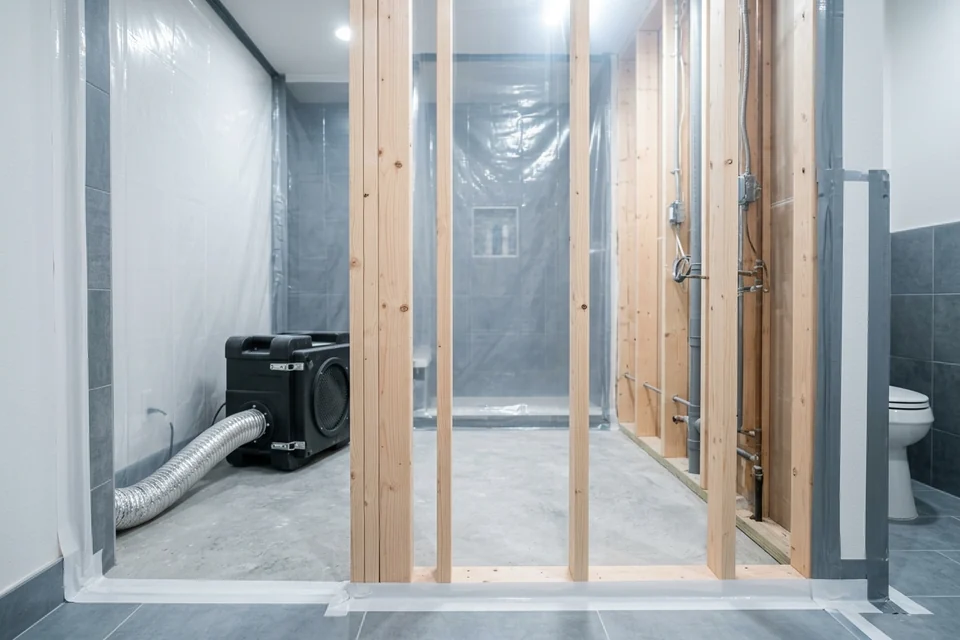
Clean open stud bay cavity verified free of suspect mold staining and settled dust
GATE 02 • UNDERLYING MOISTURE REPAIR (≤16% MC)

Verified Structural Wood Dry-Standard

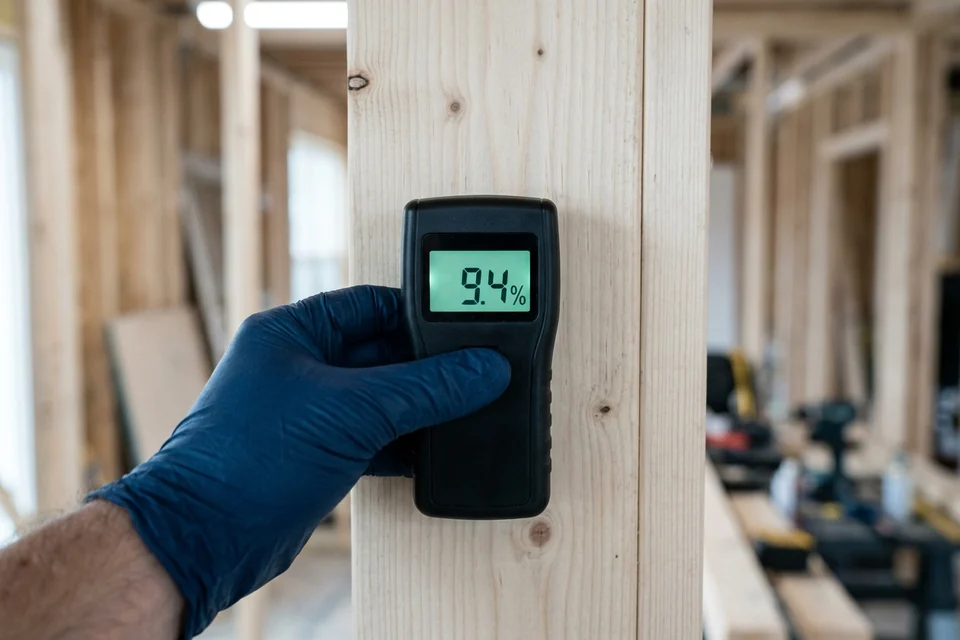
Pin-type Delmhorst conductivity readings verify bottom plates, studs, and subfloors have reached ≤16% moisture content (MC) and equilibrium parity with unaffected baseline rooms.

See Calibrated Meter Log →
Pin moisture meter verifying 9.4 percent dry-standard equilibrium in clean framing lumber
GATE 03 • CONTAINMENT & BARRIER AUDIT

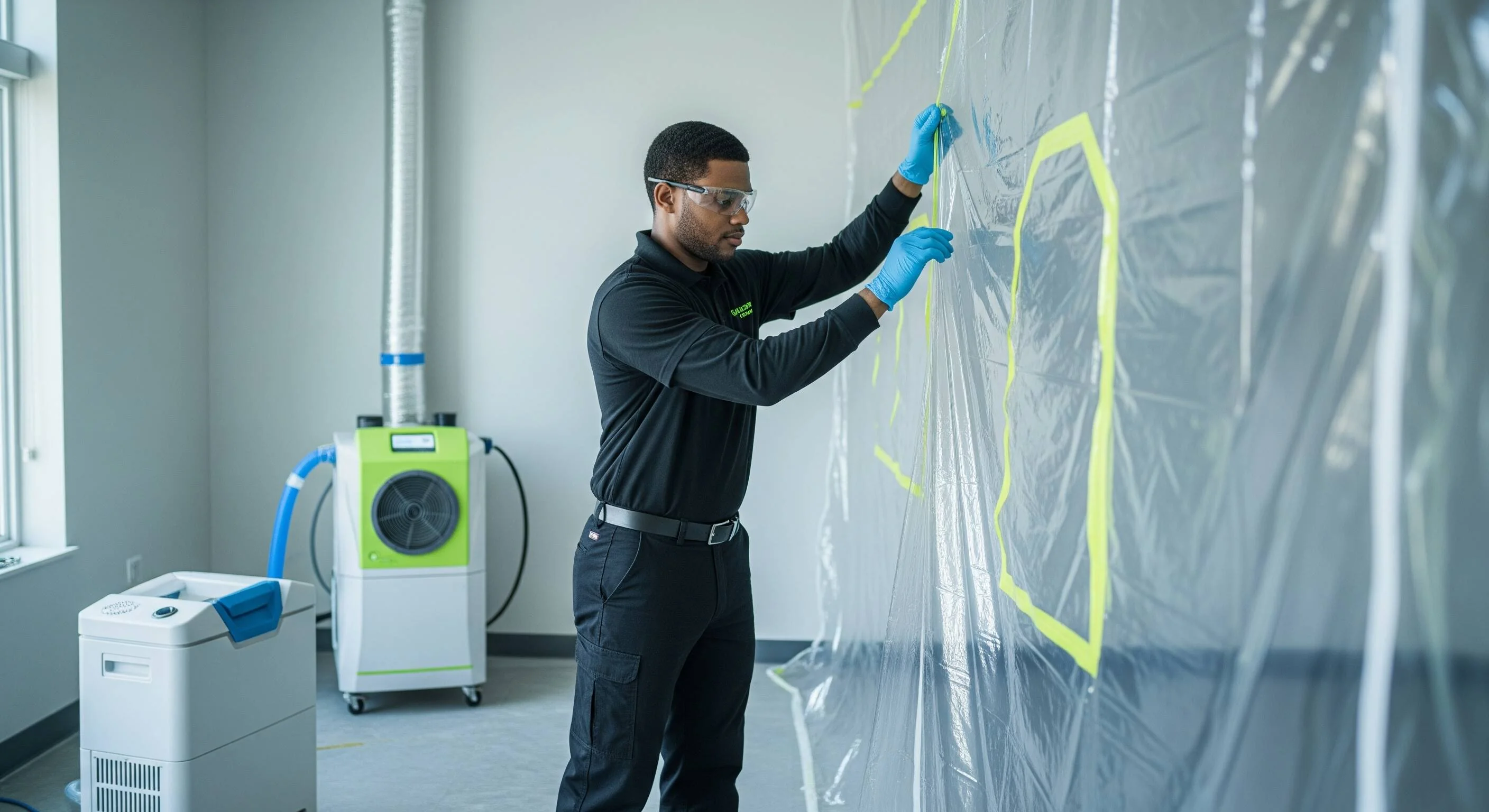
6-Mil Poly Seals & -0.020 in. wc Differential

Containment remains intact through clearance inspection. Airlocks, overlapping zipper entries, floor/ceiling poly seals, and negative-pressure differential are verified to ensure zero spore migration during abatement.

Review Containment Engineering →
Intact polyethylene containment barrier and negative-air HEPA scrubber prior to clearance release
GATE 04 • BIOAEROSOL LAB PARITY

ASTM D7391 Indoor vs. Outdoor Clearance

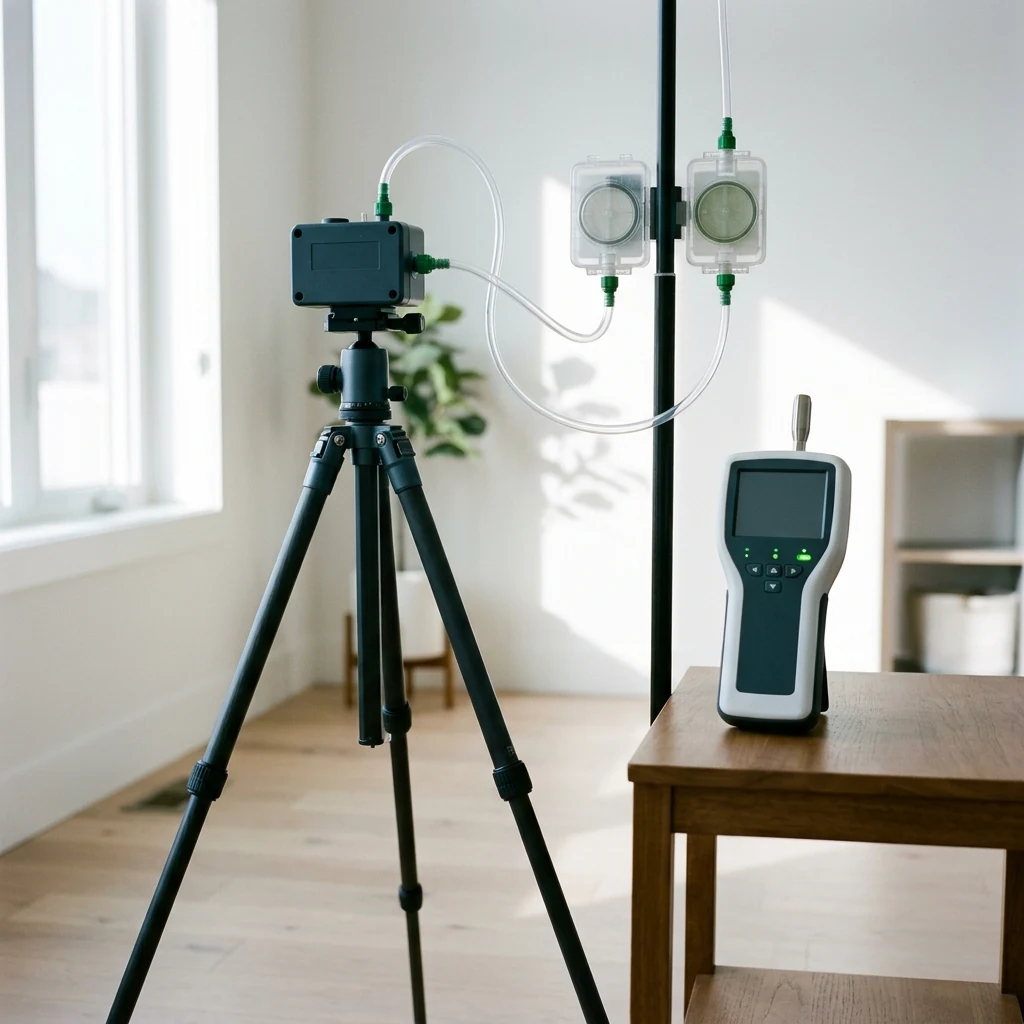
Calibrated 15.0 L/min spore traps quantify indoor clearance air against same-day outdoor baseline air: Stachybotrys/Chaetomium non-detect and total indoor/outdoor ratio aligned with S520 Condition 1.

Triggers CMDR Box B Execution →
Primary-calibrator-verified 15.0 L/min bioaerosol spore trap air clearance pump setup
OBJECTIVE BENCHMARKS • 16 TAC § 78.140

PRV Pass vs. Hold Benchmarks

Pre-defined quantitative thresholds protect owners against premature rebuilds and provide transparent rules for contractors.

Clearance Parameter Pass Standard (Release Containment) Verification Method Hold / Re-Clean Trigger
Structural Moisture PASS ≤ 16.0% MC & ≤3% over dry control wood Calibrated Delmhorst Pin Moisture Meter Active plumbing leak or wet lumber (>16% MC)
Visual Cleanliness PASS SURGICAL Dust-free framing & clean floor/poly White-light high-lumen visual + wipe check Visible fungal growth, debris, or drywall dust film
Water-Indicator Spores NON-DETECT Stachybotrys, Chaetomium, Ulocladium ASTM D7391 15.0 L/min Spore Trap @ 600× Any persistent elevation over normal background
Indoor / Outdoor Ratio CONDITION 1 PARITY Indoor total < Outdoor baseline Same-day outdoor control vs containment zone Penicillium/Aspergillus spike or amplification ratio >1.0
Statutory Form CMDR BOX B SIGNED Eligible for TDI MDR-1 16 TAC § 78.150 Assessment Signatory Protocol deviation or unverified moisture source
CLEARANCE PACKAGE • 4-PAGE SPECIMEN

PRV Clearance Certificate & MDR-1 Part B Packet

Upon passing all four gates, Envirogyn issues your bound PRV Clearance Report pairing thermal/moisture logs, pre/post lab spore parity tables, instrument calibration traceability, and signed TDI Form PC326 MDR-1 Box B verification for your insurance carrier and closing records.

4 Gates Visual, MC%, containment & air parity
10 Days Statutory CMDR owner delivery rule
ISO QA NIST-traceable airflow & pin blocks
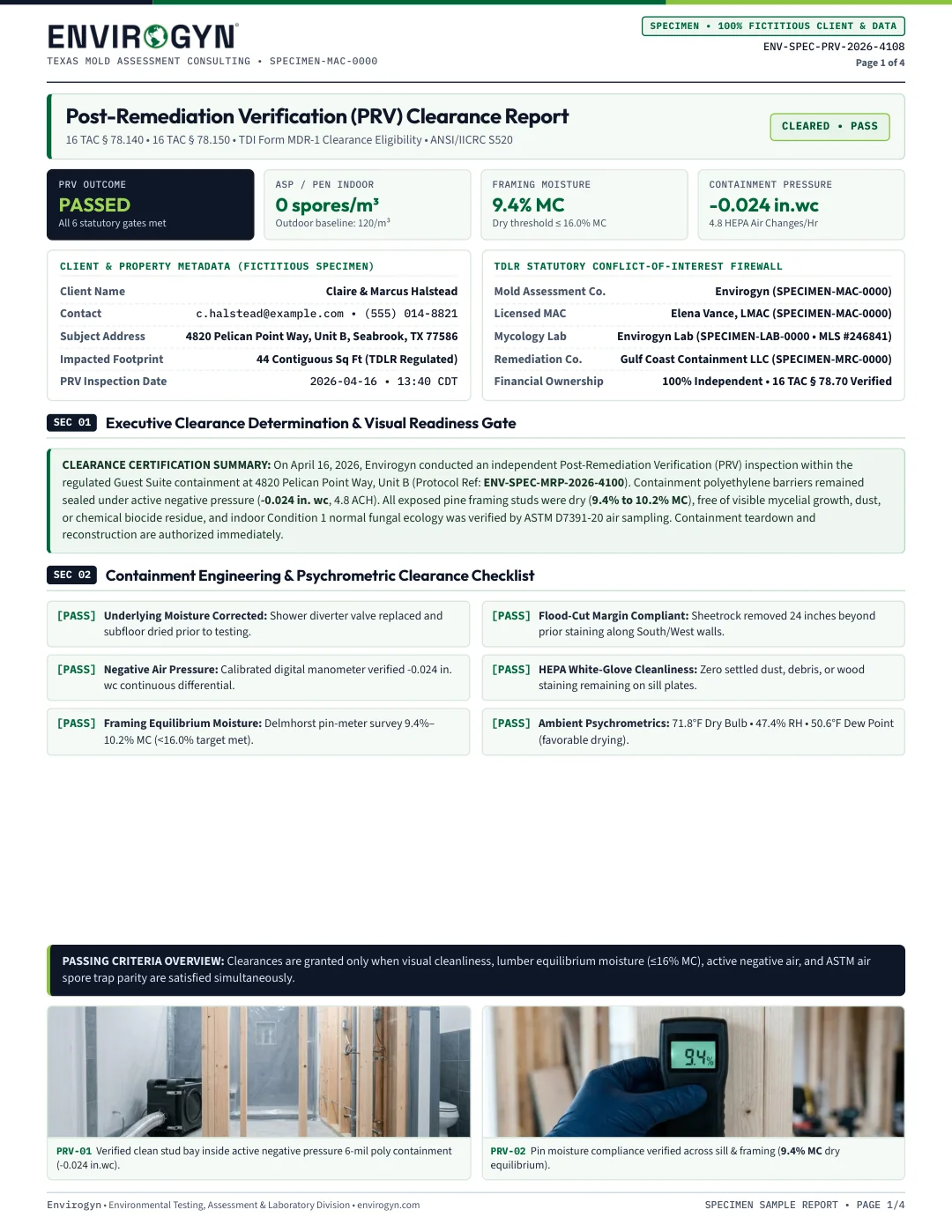
PRV Clearance Report page 1 executive summary with four clearance gates passed
PRV PAGE 1 • Four-Gate Pass Determination & Dry Readings
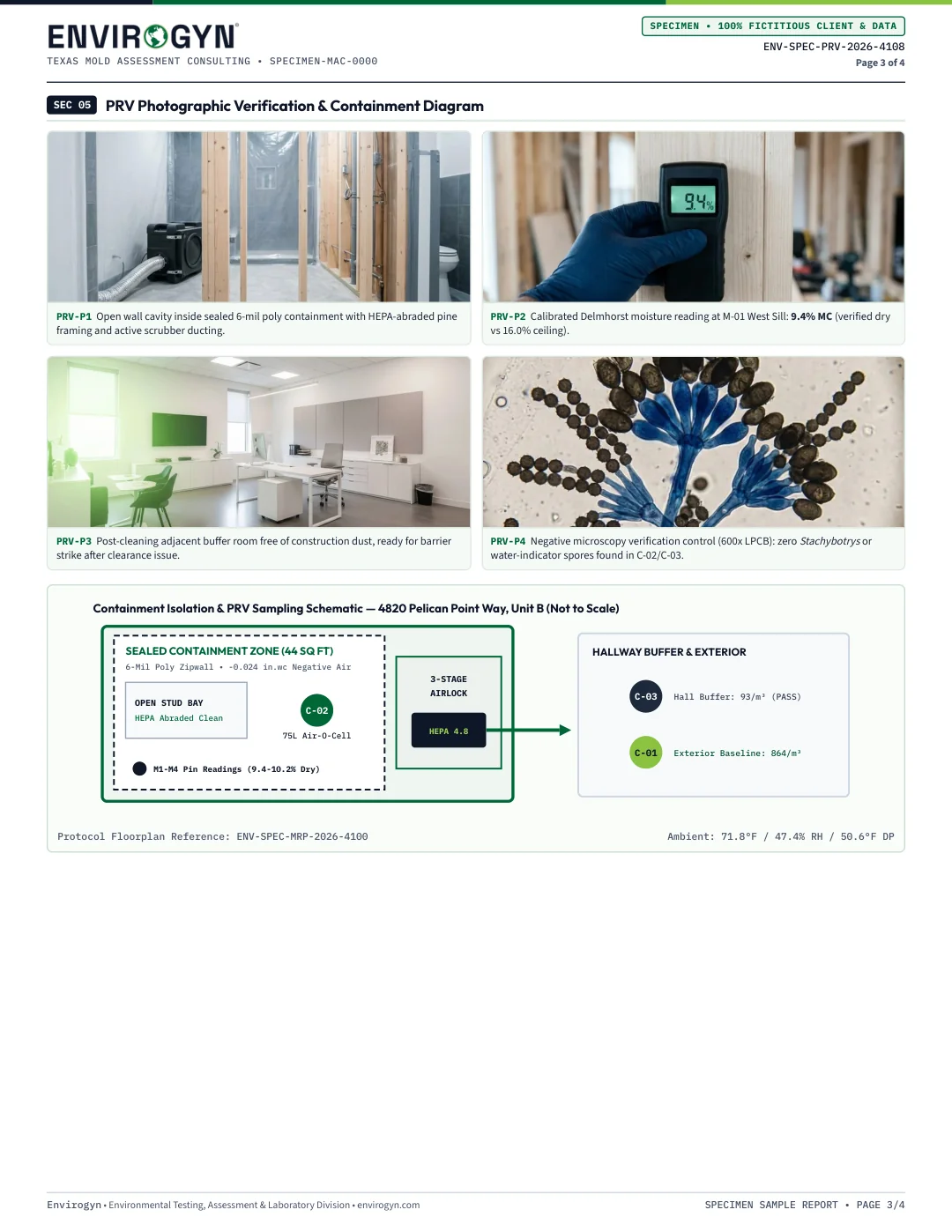
PRV Clearance Report page 3 indoor vs outdoor comparative spore parity table
PRV PAGE 3 • Comparative Indoor / Outdoor Air Parity Lab Data
PRV CLEARANCE RATES

Book Independent PRV Clearance

Keep remediation containment sealed until Envirogyn confirms your final numbers pass.

PRV-201 $445 / event
24–48 Hr Clearance

Residential PRV Clearance & TDI Form MDR-1 Sign-Off

Full 4-gate post-remediation inspection for single residential containments including visual clean verification, ≤16% MC pin checks, up to 3 ASCP clearance samples, and CMDR Box B.

PRV PDF + CMDR Box B CMDR Form Guide →
PRV-202 $595+ / containment
Multi-Zone Commercial

Commercial Multi-Containment PRV Clearance

Multi-room school, hospital, or commercial release protocol with multi-zone manometer audits, ASTM D7391 indoor/outdoor air parity, and phased sign-off.

Commercial PRV Dossier CMDR Form Guide →
PRV-203 $245 / re-test
Priority Return Visit

Failed-PRV Containment Re-Inspection Visit

Targeted return inspection and verification lab testing after contractor corrective HEPA cleaning or secondary drying of a failed containment.

Re-Test Lab Certificate Sample Report →
PRV-204 $650 / monitoring
Active Containment QC

Remediation Containment & Negative-Air Oversight

In-progress field verification before teardown: inspects 6-mil poly barrier seams, 3-stage airlock decon, negative-air pressure logs, and flood-cut bounds.

Compliance Field Log Protocol Standards →
TEXAS SEPARATION OF DUTIES • TEX. OCC. CODE § 1958.155

Objective Findings Without Remediation Conflict

Texas law prohibits the same entity from writing a remediation protocol or performing Post-Remediation Verification (PRV) on the same project where it performs contracting work. When Envirogyn serves as your Mold Assessment Consultant, we deliver unbiased thermal diagnostics, calibrated ASTM lab counts, written Mold Remediation Protocols, and independent PRV clearance — while recommending zero remediation upsells.

Review Texas TDLR Standards →
REGULATORY & TECHNICAL FAQ

Post-Remediation Verification FAQ

Timing, containment rules, moisture pass criteria, and TDI Form PC326 MDR-1 sign-off.

What are the four mandatory passing gates in Post-Remediation Verification (PRV)?

1) Surgical visual cleanliness showing zero suspect residue, settled dust, or odor inside containment; 2) Structural framing pin moisture ≤16% MC (with wood equilibrium matched to unaffected control rooms); 3) Unbreached negative-air containment held at ≤-0.020 in. wc until release; and 4) Outdoor-parity ASTM D7391 air counts and clean bio-tape confirmation.

How does PRV connect to the Certificate of Mold Damage Remediation (TDI Form PC326 MDR-1)?

Passing PRV triggers Box B certification by your Mold Assessment Consultant on TDI Form PC326 MDR-1. Paired with Box A from the Mold Remediation Contractor, the form proves your property was lawfully cleared under 16 TAC § 78.150 and Tex. Ins. Code § 544.303.

When should I schedule PRV clearance?

Schedule PRV after your remediation contractor finishes wire-brush HEPA abrasion, completes all structural drying, leaves negative-air containment standing, and shuts down air scrubbers 2 hours prior to baseline clearance air sampling (if containment scrubber rest protocol applies — coordinate exact dwell with our desk). Do NOT tear down containment before PRV passes!

What happens if containment fails PRV clearance?

If residual moisture exceeds 16% MC, staining remains, or elevated spore traps indicate cross-contamination, containment stays erected while the contractor performs targeted re-cleaning. We then schedule PRV-203 ($245) for rapid priority re-inspection.

Can I book PRV if a different Mold Assessment Consultant wrote the protocol?

Yes. Provide the active Mold Remediation Protocol and the contractor's remediation notice documentation when scheduling so Envirogyn can verify every specified cut line and clearance threshold objectively.

Call (281) 694-5742